





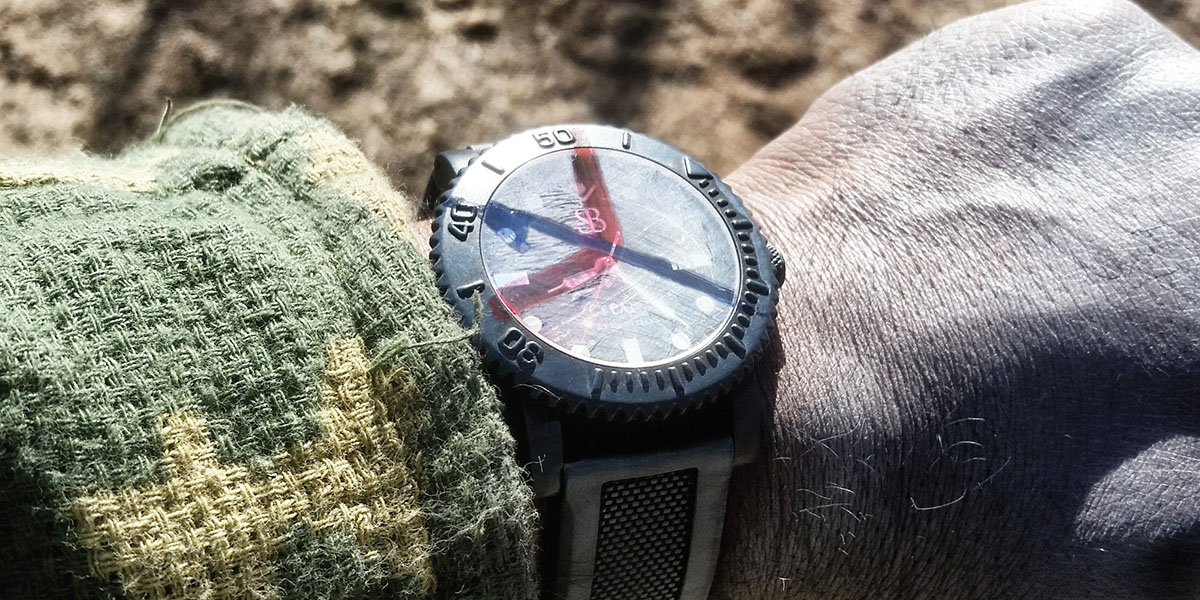
Far more than a simple accessory, a good watch can quietly become one of the most useful tools you own. Modern smartwatches already proved that a device on your wrist can track your heart rate, show notifications, and even guide you around town. So it’s not a stretch at all to imagine what a watch specifically built for the outdoors can do. That’s where survival watches come in. These are timepieces designed to earn their place in your gear list, giving you quick access to information like temperature, direction, weather trends, altitude, and more. Even if nothing dramatic happens on your trip, having that data on your wrist makes hiking, camping, hunting, and general backcountry exploring smoother, safer, and a lot more controlled.
If the worst happens and you do get turned around or stuck far from help, that same watch stops being “nice to have” and starts feeling essential. A survival watch won’t magically teleport you back to the trailhead, but a compass bearing, a barometer warning you about incoming bad weather, or an accurate altimeter can be the difference between wandering blindly and making a deliberate move toward safety. Of course, you should never depend on a survival watch alone: proper planning, maps, navigation skills, and staying on marked routes always come first. But when you realize you missed a turn, the daylight is fading, and the weather is shifting, you’ll be very glad that there’s a serious piece of kit ticking away on your wrist instead of a fragile fashion watch.

The Best Survival Watches
Putting together a list of genuinely reliable survival watches wasn’t something that could be done by glancing at specs and marketing photos. On paper, almost every rugged watch looks impressive, especially during the first few days of ownership when everything is still new and shiny. Because of that, we dug deep into long-term owner feedback, stress tests, and our own experience out in the field to filter out the models that only look tough from the ones that actually stay useful after mud, rain, bumps, and years of wear.
That process took time. We cross-checked durability complaints, sensor accuracy, battery behavior, and little real-world details that only show up once someone has lived with a watch for a while. The result is a list we’re genuinely confident in. Every survival watch below does what it’s supposed to do under pressure. Some models are straightforward and focus on toughness and simple timekeeping plus a couple of core functions. Others are packed with advanced sensors and navigation features that turn your wrist into a mini survival console.
The important point is that every watch on this list is something you can trust when conditions get rough, not just when you’re sitting at your desk reading the manual.
1. Casio G-SHOCK Mudmaster Survival & Outdoor Watch
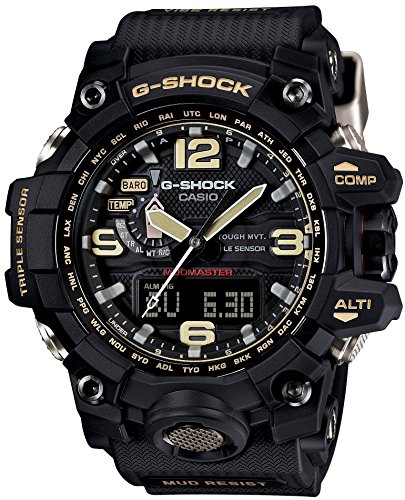
Casio has been a dominant name in the tough-watch world for decades, and the Mudmaster shows exactly why so many adventurers, military personnel, and outdoorsy types gravitate to the G-SHOCK line. This model is built with hostile environments in mind: dusty trails, muddy tracks, hard knocks against rock or metal, and sudden downpours are all part of the design brief rather than an afterthought.
The case and bezel use high-grade synthetic materials and a chunky, shock-absorbing structure that helps the watch shrug off impacts that would shatter a more delicate piece. The outer edge is heavily armored and textured, so bumps and drops during climbing, scrambling, or working around vehicles are unlikely to do more than scuff the surface. The internals sit inside an impact-resistant structure that’s become a G-SHOCK signature.
True to its name, the Mudmaster is both mud-resistant and shock-resistant, and it’s also water-resistant to a depth that easily covers swimming, heavy rain, and most wet-weather scenarios you’ll realistically face in the field. You can wear it in creek crossings, while washing gear, or during sudden storms without worrying about killing your watch.
Power is handled in a smart way as well. Instead of relying purely on disposable batteries, the Mudmaster uses an efficient solar charging system. When the watch is stored in total darkness, the built-in power reserve can keep it alive for up to roughly 25 months. Under normal use outdoors, the solar panel on the dial quietly tops up the battery whenever it sees light, which is ideal for long trips or emergency use where you don’t want one more item on your “remember to change” list.
In terms of survival-relevant features, the Mudmaster gives you direction information via a built-in compass, temperature readings, and barometric pressure data. Those three together give you a quick snapshot of where you’re heading and what the weather is doing, which is exactly what you need when you’re trying to make decisions under stress.
The primary display is analog, with bold hands and hour markers that are easy to see at a glance, even when you’re moving. A small digital window adds the extra data: compass bearing and other readings appear there when you call them up. LED illumination makes the face readable in low light, and the hands and markers are coated with luminous paint so you can still read the time without constantly using the backlight and draining your stored power.
Pros for this model are pretty clear: you get a seriously tough watch that doesn’t mind getting bashed around, a solar charging system that reduces battery worries, and a useful set of survival functions without feeling like a computer strapped to your arm. The main downside is sheer size. The Mudmaster can look and feel big on smaller wrists, and if you’re used to slim dress watches, it’ll take a little time to get used to the bulk.
2. Citizen Eco-Drive Promaster Altichron Multifunction Watch

Citizen’s Promaster Altichron is one of those pieces that manages to look good with casual clothes in town but is clearly built for mountains, trails, and long days outside. It combines a sleek, sporty style with real functionality rather than just “outdoor-inspired” decoration, which makes it a solid choice if you want one watch that can move between everyday life and serious trips.
The case uses black-ion plated steel and a dark dial with red accents that keep things legible without looking too flashy. Under the surface, the watch is powered by Citizen’s Eco-Drive technology, which means the movement is quartz-accurate but powered by light rather than disposable batteries. Any decent light source—sunlight, overcast sky, or artificial indoor lighting—can charge the internal cell, so as long as you don’t lock the watch in a drawer for months, it stays ready to go.
Function-wise, the Promaster Altichron gives you a compass, date display, and a very capable altimeter. The altitude sensor is rated to cover roughly 1,000 to 35,000 feet, which comfortably spans everyday hiking, alpine routes, and even air travel. For anyone who spends time in the mountains, being able to check altitude without pulling out a separate device is genuinely useful for navigation and pacing.
Protection is handled by a black-ion steel case and an anti-reflective mineral crystal over the dial. The crystal helps cut glare when you’re in bright sun, and it’s tough enough to resist minor impacts and scratches. The entire watch is water-resistant to around 200 meters, so swimming, snorkeling, and heavy rain are no problem at all.
The strap is made from black polyurethane, which keeps weight down and doesn’t soak up water like leather or some cheap fabrics. It’s flexible, comfortable on the skin, and low-maintenance, which matters more than you think when you’re wearing the watch for long hours day after day.
Overall, the Promaster Altichron feels like a survival-ready field watch first and a good-looking daily watch second, which is exactly the balance many people want. You get an effective altimeter and compass, strong materials, and solid water resistance at a price range that’s often more accessible than some of the more extreme high-end survival pieces. The trade-off is that it doesn’t try to pack in every conceivable sensor or GPS feature, so if you want deep mapping integration, you’ll need to step up to more complex options.
3. Casio G-SHOCK Rangeman Solar-Assisted Survival Watch

The G-SHOCK Rangeman sits near the top of Casio’s survival line and is widely considered one of the most capable wrist tools you can buy if you care about ruggedness and serious features. It builds on G-SHOCK’s classic toughness and adds a navigation layer that pushes it toward the “mini wrist computer” category in a good way.
One of the big standout features is built-in GPS. Instead of just telling you which way north is, the Rangeman ties into satellite signals to calculate your actual position. On the watch itself you can view your current location, log your movement as you travel, and create a track that you can follow in reverse if you need to backtrack to a previous point. For multi-day hikes, hunting trips, or bug-out plans, that breadcrumb trail is incredibly reassuring.
The GPS data isn’t locked inside the watch either. By pairing it with your smartphone over Bluetooth, you unlock additional tools inside Casio’s companion app, such as 3D maps and route-planning options. That makes it easier to visualize where you’ve been and where you want to go next without carrying a dedicated handheld GPS unit.
In addition to navigation, the Rangeman uses Casio’s triple sensor system to measure compass bearing, barometric pressure, and temperature. All three can be displayed on the LCD readout, giving you quick feedback about changing weather, elevation trends, and direction. Being able to glance down at your wrist and see a pressure drop or a sudden shift in temperature can help you decide whether to push on or set up camp before conditions deteriorate.
The display itself is a full LCD digital screen rather than an analog/digital hybrid. That allows clear graphic representations, icons, and numerical data without clutter. Even with a lot of information on the screen, Casio does a decent job of keeping it readable.
Build quality is what you’d expect from a premium G-SHOCK: heavily armored case, impact-resistant structure, and water resistance to around 200 meters. You can wear it in the rain, underwater, or in mud without worrying about destroying the internal electronics.
Power management is very deliberate. On a full charge, the GPS functionality can run continuously for roughly 33 hours. If you find yourself low on power, you can disable GPS and still rely on the watch as a timekeeper and basic tool while the solar charging system slowly refills the battery whenever light is available. That layered approach means the watch doesn’t just die completely when GPS drains the battery.
On the positive side, you’re getting accurate GPS navigation, classic G-SHOCK durability, an easy-to-read digital face, and a wide set of functions that cover both everyday use and serious emergencies. The clear downside is cost: the Rangeman sits in a higher price bracket than most basic survival watches. For someone who actually uses the advanced sensors and navigation tools, the investment can be justified, but it’s more than you need if you only want simple timekeeping and a compass.
4. Suunto Core Military Outdoor Survival Watch

Suunto’s Core Military-style watch has become a bit of a modern classic in the outdoor world. It’s noticeably slimmer and cleaner than many bulky survival watches, which makes it easy to wear every day without feeling like you’re lugging around a brick on your wrist. Despite that lower profile, it still packs a very practical feature set.
The face is a full LCD display instead of analog hands. That gives the watch the flexibility to show altitude data, barometric trends, compass bearings, and time in different layouts without needing multiple sub-dials. The flat, high-contrast design is especially convenient when you’re trying to read data quickly in changing light.
As an altimeter watch, the Core can monitor your ascent and descent in real time and log your altitude profile over a trip. That’s handy not only for mountaineering but also for keeping an eye on how hard you’re working during long hikes. The watch can show how much vertical gain you’ve accumulated and how fast you’re climbing.
Weather tracking is where the Core really earns its survival reputation. The built-in barometer constantly tracks changes in air pressure, letting the watch plot a weather trend graph. A sudden, sharp drop in pressure is often a sign that a storm is approaching. The Core uses that information to trigger a storm alarm, giving you an early warning to find shelter, adjust your route, or at least mentally prepare for rougher conditions.
Another thoughtful feature is the sunrise and sunset time database. With stored data for more than 400 locations worldwide, the watch can tell you when you can expect daylight to begin or end in your area. That makes it easier to plan when to break camp, when to turn around on a trail, or how much light you realistically have left before darkness.
From a durability standpoint, the Core has a solid track record, especially for its price point. It’s designed as a tool rather than a jewelry piece. The main criticism it gets is that the band isn’t the most bombproof part of the package and may eventually need replacing if you’re especially hard on your gear. Still, the combination of a clear LCD screen, reliable weather monitoring, and straightforward interface makes it a favorite for people who want a survival-capable watch that doesn’t scream “tactical gadget” every time they look at it.
5. Casio Pro Trek Stainless Steel Quartz Survival Watch
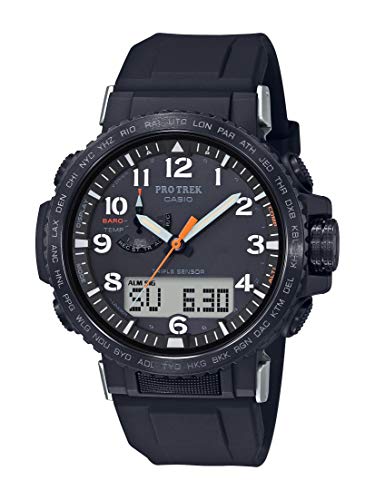
Casio’s Pro Trek line is built around the idea of precise outdoor information, and this stainless steel model is a strong example of that philosophy. While the movement itself is a quartz unit, Casio couples it with systems that push timekeeping and sensor accuracy beyond what you’d expect from a basic field watch.
One of the key technologies inside is multi-band atomic timekeeping. Instead of relying solely on the internal quartz oscillator, the watch periodically receives calibration radio signals—typically five or six times per day, depending on your region. Those automatic corrections keep the time extremely accurate without you having to touch anything, which is reassuring when you’re coordinating meet-ups or timing critical tasks.
The Pro Trek is equipped with Casio’s Version 3 Triple Sensor system, which handles altitude, barometric pressure, and temperature. Compared to simpler, entry-level sensors, this system is noticeably more sensitive and precise. In practical terms, that means your altitude readings stabilize faster, pressure changes are tracked more cleanly, and temperature data is closer to reality—especially once you account for body-heat effects.
For navigation, the Pro Trek includes a digital compass that shows the direction you’re facing and can store a bearing in memory so you can keep walking in a chosen direction even after the display returns to normal time mode. Having that digital representation rather than a tiny analog pointer makes it easier to use under stress.
The stainless steel housing gives the watch a more traditional, premium feel while still being ready for rough use. It’s resistant to dings and scratches and offers good structural protection for the movement and sensors. Water resistance reaches roughly 100 meters, which is plenty for swimming, rain, and general wet-weather use.
Like several other Casio survival watches, this Pro Trek uses solar power to keep the battery topped up. The dial hides a solar panel that converts light into energy, and the watch manages its power carefully with features like a power-saving mode. Even with the sensors running, battery life is solid as long as the watch sees light regularly.
All things considered, this model hits a nice balance between toughness, precision, and price. It’s extremely durable, loaded with useful functions, and often represents very good value when you realize how much tech is packed inside. It’s fractionally less overbuilt than a heavyweight G-SHOCK, but for many users that’s an acceptable trade for a slightly cleaner and more traditional look on the wrist.
6. Victorinox I.N.O.X. Pro Titanium Survival Watch
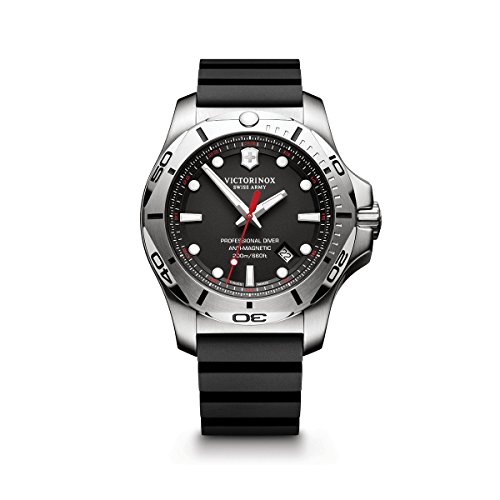
If your top priority is owning a watch that can take abuse without flinching, the Victorinox I.N.O.X. Pro is hard to ignore. At a glance, it looks like a simple, handsome Swiss dive watch. A closer look—and real-world testing—shows a case and construction designed to handle far more than a casual swim in a hotel pool.
The case measures around 45 millimeters and is crafted from titanium rather than standard steel. Titanium offers a very attractive combination of properties for survival gear: it’s strong enough to withstand serious impacts, but much lighter than steel, which keeps the watch from feeling like a weight strapped to your arm during long days. It also handles corrosion very well, which matters if you’re around saltwater or sweat constantly.
This model is a certified diving watch that meets rigorous NIHS 92-11 standards, and it carries a water resistance rating of about 200 meters. For everyday users, that translates into more than enough protection for swimming, diving, and relentless exposure to rain or spray. Internals are fully sealed, so dust, grit, and moisture stay out of the movement.
The dial is protected by a tough crystal and surrounded by a functional dive bezel, which can be used to track elapsed time in a simple, intuitive way. Even though this isn’t a sensor-packed GPS watch, it fits firmly into the survival category because it’s one of those tools that just keeps working when everything else starts to fail.
A nice touch with this particular I.N.O.X. variant is the strap setup. You typically get two tough options: a classic rubber strap that handles water and sweat without complaint, and a paracord strap woven from lightweight nylon rope. That paracord isn’t just for looks. In a pinch, you can unravel it and use the cordage for tying gear, making improvised repairs, or even basic emergency tasks like creating a shelter line.
It’s true that this model doesn’t come loaded with compasses, altimeters, and GPS, so if you want a full sensor suite on your wrist you’ll need to look elsewhere. But as a bombproof, always-on timekeeper that shrugs off abuse while adding the bonus of usable paracord, the I.N.O.X. Pro has a very strong case as a serious survival companion.
7. Suunto Traverse Alpha Multifunction Survival Watch

The Suunto Traverse Alpha is aimed squarely at people who spend a lot of time outdoors, especially hunters and backcountry explorers who move through remote terrain. It combines a rugged physical design with thoughtful digital features that go beyond simple time and altitude readings.
The case uses knurled stainless steel with a protective brown coating, giving it both a tactical look and extra resistance to scratches and dings. Over the dial, Suunto uses sapphire crystal, which is significantly tougher than ordinary mineral glass and far less likely to scratch when you brush past rock faces, tree trunks, or metal surfaces.
The strap is made from nylon, chosen for its blend of flexibility, durability, and low water absorption. It’s easy to adjust, comfortable against the skin, and doesn’t stay wet for long after you’ve crossed streams or walked through wet grass.
Inside, the Traverse Alpha is built around GPS-enabled features. The watch can quietly track your route in the background, logging GPS coordinates at intervals to form a breadcrumb trail. If you ever need to retrace your steps—whether because visibility dropped, you’re heading back to camp, or you want to revisit a successful hunting spot—the stored trail gives you a reliable guide.
Suunto also adds niche but genuinely useful tools such as a moon phase calendar, which can be helpful for planning hunts or fishing trips where lunar cycles influence animal behavior. Combined with sunrise and sunset times, that makes it easier to schedule when you move, when you stay put, and when you expect the most activity.
The overall interface tends toward minimalism: the readout is text-based and straightforward rather than flashy, which some people love and others find a bit too bare. On the plus side, that simplicity usually makes data easier to read quickly in poor light or when you’re exhausted.
On the durability front, the Traverse Alpha feels like a watch designed to be knocked around. Stainless steel, sapphire glass, and a tough nylon strap give you a package that’s ready for repeated field use. About the only real criticism is that the minimalist display style won’t appeal to everyone. If you want bright colors and constant animations, this isn’t that kind of smartwatch. If you’d rather have a tough, quiet tool that logs your movement and keeps working when you’re miles from signal, it fits the role well.
8. Timex Expedition Gallatin Budget-Friendly Survival Watch

Not everyone wants—or needs—to spend hundreds of dollars on a survival-capable watch. The Timex Expedition Gallatin steps in as a budget-conscious option that still brings enough toughness and practicality to earn a place in your gear, especially as a backup or starter piece.
This watch doesn’t pretend to be a full sensor platform, and that’s actually part of its charm. Instead, it focuses on being a reliable, easy-to-read timekeeper with light outdoor-ready features. The case is made from resin, which is strong enough to handle everyday bumps, scrapes, and minor impacts while keeping weight low. The design is rugged and outdoorsy without becoming oversized or cartoonish.
The face uses a black dial with clear numerals and a date window at the three o’clock position. Timex’s well-known Indiglo backlight system lets the entire dial glow for nighttime visibility, making it easy to check the time in a tent, on a night hike, or during power outages without needing a separate flashlight.
Covering the dial is an acrylic lens. While acrylic isn’t as scratch-resistant as sapphire, it’s reasonably tough and can survive plenty of casual abuse. For the price point, it does the job. A double-layer nylon slip-through strap secures the watch to your wrist. Nylon straps are a good match for outdoor use because they dry quickly, tolerate sweat and water, and are easy to replace if they eventually wear out.
Water-resistance is rated to around 50 meters. That’s enough for light swimming, getting caught in heavy rain, or repeatedly dunking your hands in water. It’s not a dedicated dive watch, but it’s certainly not fragile around moisture.
On the pro side, the Expedition Gallatin is inexpensive, reasonably durable, and simple to use. You’re not dealing with menus, sensors, or complicated settings—just time, date, and a solid glow-in-the-dark dial. The obvious limitation is that there are no advanced survival functions like a compass, altimeter, or GPS. If you already have other navigation tools or just want a tough everyday watch that can hold its own outdoors, it’s a good fit. If you want your watch to be a full navigation backup, you’ll need something higher up this list.
9. Seiko NATO Strap Automatic Field Watch
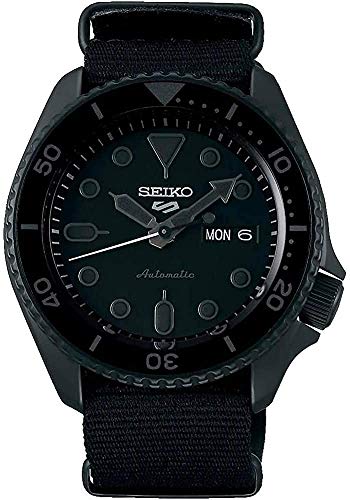
This Seiko model brings traditional mechanical watchmaking into the survival context. Instead of running on a disposable battery, it uses an automatic movement that winds itself from the motion of your wrist. That makes it particularly appealing for people who like the idea of a watch that can keep running as long as they keep moving.
The case is made from stainless steel, giving the watch a solid, reassuring feel and good resistance to impact and wear. Seiko adds a hard coating over the metal, which adds another layer of protection and helps preserve the finish when the watch inevitably scrapes against rocks, gear, or doorframes. The hard-coated surface also gives the watch a darker, more tactical appearance compared to plain polished steel.
A NATO-style nylon strap holds the watch in place. NATO straps are popular in the field because they’re simple, secure, and can keep the watch attached even if one spring bar fails. The hardware on the strap is made from the same hardened steel, tying the whole package together visually and structurally.
The dial layout is clean and functional. Large hands and hour markers make the time easy to read at a quick glance, and there’s a small day-date window to help you keep track of your schedule. There aren’t extra sub-dials or sensor readouts here; the focus is on dependable mechanical timekeeping.
In a survival or long-term emergency scenario, the automatic movement is a quiet advantage. As long as you wear the watch regularly, the rotor inside keeps the mainspring wound, so there’s no battery to drain and no dependency on sunlight or chargers. That said, mechanical movements do have their own quirks: they’ll gradually drift and need occasional manual winding or time correction, and they don’t offer the absolute precision of quartz.
The main strengths of this Seiko are its robustness, its self-powered nature, and its straightforward legibility. On the downside, it doesn’t include built-in survival extras like a compass or altimeter, so if you want those tools on your wrist you’ll need to pair this with separate gear. For someone who wants a tough, traditional automatic watch that can handle rough environments without constant battery management, it’s a very appealing option.
10. Luminox Leatherback Sea Turtle Giant Survival Watch
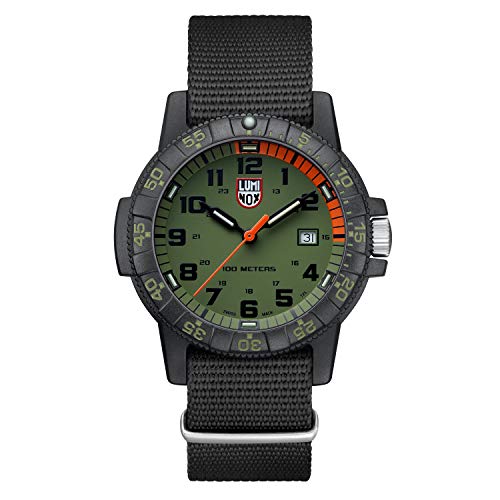
The Luminox Leatherback Sea Turtle Giant is designed for people who need a tough, always-visible watch that won’t disappear the moment the sun goes down. Luminox has a long history of supplying military and law-enforcement units, and this model carries that DNA into a design that’s ideal for survival and field use.
The case measures about 44 millimeters and is made from a carbon-based material known as Carbonox. This composite is lightweight yet impressively strong, resistant not only to physical shocks but also to temperature changes and many chemicals that would discolor or weaken cheaper plastics. For real-world use, that means you can expose the watch to heat, cold, and dirt without babying it.
The dial itself is bright and uses bold numerals for quick legibility. What really sets it apart, though, is the way Luminox handles low-light visibility. Instead of relying solely on standard luminous paint that fades after a short time, the watch uses long-lasting illumination elements around the hands and hour markers. The glow effect is designed to remain visible for years—up to around 25 years—without needing to be “charged” by ambient light. In a dark tent, blackout, or night operation, that constant readability is a big advantage.
Around the dial sits a unidirectional rotating bezel. Originally designed for diving, a bezel like this can be used to track elapsed time by setting the marker against the minute hand and watching how far it moves. In survival contexts, it can help you keep an eye on time spent on tasks, rest breaks, or decompression stops if you’re actually diving.
The watch is also protected by a hardened mineral crystal over the face, adding scratch and impact resistance to the display. Water resistance hits roughly 100 meters, which is more than enough for swimming, surface water activities, and heavy rain.
In terms of strengths, the Leatherback Sea Turtle Giant stands out for its rugged Carbonox construction, genuinely useful constant-glow visibility in the dark, and solid bezel design. Weak points are mostly about what it doesn’t do: it doesn’t come with altimeters, barometers, or GPS, and some users find that the bold dial can be slightly less crisp in very bright daytime conditions compared to more minimal designs. Still, as a tough, easy-to-read piece that works day and night, it fits survival use very well.
11. Victorinox Swiss Army Professional Dive Watch
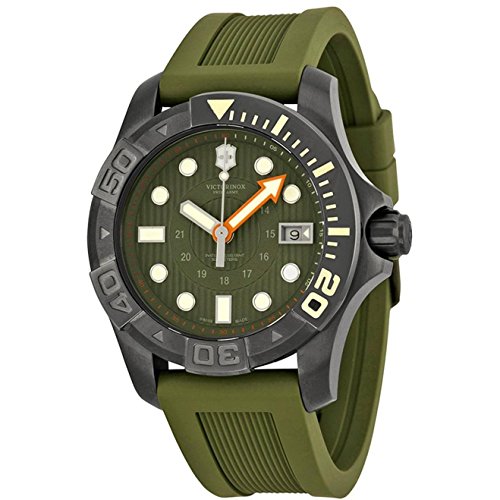
This Swiss Army watch from Victorinox leans hard into the “indestructible tool” side of the spectrum. It’s built to survive serious pressure and rough handling, making it a strong candidate for anyone who wants their wristwatch to be almost comically overbuilt.
The housing is stainless steel, with enough thickness and structural strength to handle frequent knocks, scrapes, and temperature changes. Surrounding the dial is a gun-metal bezel that has been ion-plated for extra hardness and corrosion resistance. Despite that tough coating, the bezel is designed to rotate smoothly, giving you the ability to track elapsed time in a classic diver’s fashion.
The headline feature here is water resistance. Where many field watches top out at 100 or 200 meters, this Victorinox pushes all the way to a rating around 500 meters. For actual diving, that’s far deeper than most people will ever go, but the practical implication is that seals and gaskets are beefed up across the board. Heavy rain, high-pressure water jets, or extended immersion are simply not a concern.
The crystal over the dial is made from tough material suited to regular impacts, and all the external components are chosen for durability rather than delicacy. This is not a watch that cries if you bang it against a rock while climbing out of a river.
On the pro side, you get a timepiece with a face made from strong materials, a case that shrugs off both pressure and impacts, and water resistance that outclasses most competitors. The downside is that, by design, it doesn’t add extra survival data like compass bearings, altitude, or weather trends. If you pair it with separate navigation tools, it can be a rock-solid companion. If you’re hoping for an all-in-one sensor package, this watch plays a different role: simple, bulletproof timekeeping in environments that would kill many other watches.

Understanding What A Survival Watch Really Is
When things go sideways far from home, the right survival watch isn’t just a piece of jewelry—it quietly becomes one of the tools you lean on while you’re trying to get yourself back to safety. Whether you’re dealing with a large-scale disaster in your city or you’re simply deep in the wilderness with no easy way out, having reliable information on your wrist can make the difference between wandering blind and making informed decisions.
A survival watch, at its core, is a multifunction timepiece built specifically to keep working in harsh environments while delivering practical data. Fancy designer watches and fragile smartwatches might look impressive at a dinner table, but many of them simply aren’t designed to handle repeated impacts, soaking rain, and days without easy charging. They may tell the time accurately, but once conditions get rough, their limitations show up quickly.
By contrast, survival watches are designed around safety and function first. They certainly tell time, but they also offer information that can be critical in an emergency. Common features include a compass, an altimeter to track height above sea level, a thermometer to monitor temperature, and a barometer to read air pressure.
The compass and altimeter are especially valuable when you’re off-trail or trying to orient yourself. A good bearing and a sense of your altitude give you clues about where you are on a map, which direction leads out, and how far you might be from ridges, valleys, or known landmarks. In a worst-case scenario, those numbers can also be passed to rescuers as part of your position description.
The thermometer and barometer provide another layer of context. A quick check of actual temperature can help you decide when to add layers, when to seek shade, or how aggressively you need to manage your energy. The barometer shows trends in air pressure; falling pressure often signals incoming storms or weather changes, buying you time to set up shelter or change your route.
More advanced survival watches push further by adding GPS receivers and sometimes even basic map displays. These watches can log your path, show your current coordinates, and help you backtrack along your route if visibility drops or you simply want to return to a previous point.
Just as importantly, survival watches are built from materials that are meant to endure. Tough cases, strong crystals, sealed buttons, and reinforced straps are the norm. Where a typical dress watch might crack or fog up after one unexpected swim, a well-designed survival watch is expected to keep ticking through rain, snow, dust, and hard knock after hard knock.
Smartwatches occasionally borrow some of these features, but they often rely heavily on constant connectivity, fragile touchscreens, and frequent charging. A true survival watch, on the other hand, is built on the assumption that you might not see a charger, a phone signal, or a repair shop for a long time.

Why Using A Survival Watch Gives You An Edge
Day to day, you can treat a survival watch much like any other wristwatch. It tells time, looks good enough for casual use, and quietly sits there most of the time. The moment your situation becomes more serious, though, that same watch starts earning its keep in very visible ways.
Picture a major storm or earthquake hitting your area. Communications go down, streets are blocked, and you’re trying to get your family to a safer place. A survival watch can give you direction, elevation clues, and weather trends, helping you choose routes that avoid low-lying flood zones or unstable slopes. If you’re moving through a city where familiar landmarks are damaged or obscured, being able to set a bearing and stick to it matters more than most people realize.
The information on your wrist stays useful throughout your journey. Temperature and pressure changes warn you if conditions are turning ugly again. A compass and altimeter help you confirm that you’re still heading the way you intend rather than slowly veering off course. If your watch has extra tools—like a backlight, sunrise and sunset times, or a storm alarm—those little touches can simplify dozens of decisions when your brain is already full dealing with stress.
Even outside of emergency scenarios, a survival watch integrates nicely into everyday adventure planning. On long hikes, backpacking trips, or wildlife excursions, a group can synchronize watches and agree on check-in times or meet-up points. If someone doesn’t show up when they should, the others know when it’s time to start looking or call for help rather than guessing.
Imagine you get separated from your group on a trail. If everyone agreed on times and rough locations beforehand, your friends can raise the alarm when you miss your window. Meanwhile, you can use your watch to climb to a higher vantage point, check bearings, and figure out where you went off course in the first place.
If your watch includes GPS, you can mark waypoints, track your movements, and share coordinates once you’re in contact with rescuers. Without GPS, the combination of compass and altitude still sharpens your understanding of where you might be in relation to ridgelines, rivers, or trail junctions.
The real advantage of a survival watch is that it compresses several useful tools into something you’re already used to wearing. Instead of rummaging through pockets for a separate compass, altimeter, and barometer, you flick your wrist and get a quick snapshot of your situation. When you’re tired, cold, or stressed, that kind of simplicity isn’t just convenient—it’s a safety feature in itself.
Key Things To Consider When Choosing A Survival Watch
Finding a watch that calls itself “tactical” or “survival-ready” is easy. Finding one that will still be working properly after months of hard use is a different challenge. Marketing keywords can be misleading, so it pays to look at the details instead of the slogans.
Below are the main factors you’ll want to pay attention to while you’re narrowing down your options.
Time Accuracy And Reliability
Accurate timekeeping might sound like a basic assumption, but not every feature-packed watch excels at it. The more functions a watch has, the more power demands and internal complexity it has to manage. In some poorly designed models, that can translate into small but noticeable time drift.
Losing a second here and there doesn’t feel like much… until it does. Over the course of a day, a watch that’s 99.9 percent accurate can end up roughly a minute and a half off. Stretch that over several days in the field and your carefully planned meet-ups can start to slip.
Good manufacturers often publish accuracy estimates for their movements. If you can find those numbers, aim for the highest accuracy rating you can reasonably afford. A movement rated around 99.998 percent accurate will typically drift by about one second per day, which is far easier to manage.
Quartz watches, which use an electronic oscillator regulated by a quartz crystal, are generally more precise than traditional mechanical movements. Mechanical designs, however, have improved a lot in recent years and many mid- to high-end mechanical watches are accurate enough for most practical purposes. Whatever route you choose, look for a movement with a reputation for staying on time instead of just looking at the exterior styling.
Functions And Survival-Focused Features
With survival watches, extra functions are often what you’re paying for. The trick is to decide which features you’ll actually use and which ones are mostly gimmicks for your specific needs.
Common survival-oriented tools include a compass, altimeter, barometer, and thermometer alongside the usual clock and calendar. For navigation, the compass and altimeter tend to be the stars. The compass gives you a bearing—north, south, and everything in between—while the altimeter tells you how high you are. When you cross-check those with a map, you can pinpoint your position more effectively than by eye alone. Some watches also add depth indicators, which are useful if you spend a lot of time in lakes or the ocean.
The barometer reads air pressure, which is a classic way to get an early warning about changing weather. A steady drop in pressure often precedes storms, so a quick glance at your wrist can tell you whether it’s wise to press on or find shelter. A thermometer gives you a reasonably accurate feel for actual temperature, especially once you account for body-heat effects by taking the watch off for a moment.
On top of that core set, many watches layer on smaller but helpful extras: reliable backlighting or luminous dials for night use, sunrise and sunset times, storm alerts, or even moon phase data. Solar charging panels built into the dial can keep these functions running for longer without manual intervention.
At the high end, GPS changes the game again. GPS-equipped survival watches can connect to satellites, calculate your coordinates, and log your track as you move. Advanced models display simple maps or topographic hints on the screen. Even basic GPS watches can usually set waypoints, show distance to a point, and draw a breadcrumb trail so you can safely retrace your path when conditions worsen.
Water Resistance And Protection From Moisture
In real outdoor use, your watch will be exposed to sweat, rain, splashes, and probably full immersion at some point. That makes water resistance more than a luxury: it’s a basic requirement for a survival-oriented piece.
Look for clearly stated water-resistance ratings. Even modestly rated watches can handle washing hands and light rain, but for serious outdoor work, you’ll want something that doesn’t flinch when fully submerged. Many solid survival watches are designed to stay functional down to tens of meters below the surface, and some dive-ready options are rated for depths of hundreds of meters.
It’s not just about deep water. A properly sealed case also stops humidity, condensation, and fine mist from creeping into the movement. Once moisture gets inside, it can fog the crystal, corrode metal parts, and eventually kill the watch. A good survival watch is designed to keep the elements out and the internals dry.
Shock Resistance And Overall Durability
Survival watches are expected to keep operating after drops, knocks, and all the random impacts that come with real use. Just like you wouldn’t trust a thin glass bottle in a bug-out bag, you don’t want a delicate watch that panics every time you bump it against a tree.
Shock resistance usually comes from a combination of smart case geometry, internal cushioning, and robust materials. Rubber or resin guards, reinforced lugs, and slightly raised bezels all help deflect impacts and protect the crystal. Inside the case, the movement may be mounted with shock-absorbing components that reduce the force transmitted from the case to the delicate parts.
When evaluating durability, think about how you actually move through the world. Will the watch be scraping against rocks, rifle stocks, boat decks, or climbing gear? If so, a slightly chunkier case and protective bezel might be worth the trade in bulk. The goal is to have something you can wear without constantly worrying about babying it. Mother Nature isn’t gentle, and your watch needs to be able to keep up.
Power Source And Long-Term Operation
How a survival watch gets its power is one of those details that’s easy to overlook until you’re actually away from civilization. Quartz watches with standard batteries are very accurate, but eventually those batteries run out, and if the watch has a lot of features, that day can come sooner than you expect. Smartwatches push this even further, often giving you only a day or two of runtime before needing a charge.
In a long-term emergency or extended expedition, having your primary wrist tool go dark because of a dead battery is not a scenario you want to experience. For that reason, it’s smart to think about power from the beginning.
Mechanical watches avoid batteries entirely. They rely on springs and gears, which are wound either manually via the crown or automatically through the motion of your wrist. As long as you keep them wound, they keep ticking. Kinetic and automatic systems make that even easier, converting everyday arm movement into stored energy. The trade-off is that they can drift a bit over time and don’t usually power complex digital functions.
Solar-assisted quartz watches sit in a nice middle ground. They use quartz accuracy but supplement their batteries with solar charging. As long as the watch sees light on a regular basis, the internal storage cell can last for years. Many survival watches combine solar charging with low-power modes so they can limp along for a long time even when they’ve been starved of light.
The key idea is to choose a watch whose power system matches your expected use. If you often go on multi-day trips without easy access to electronics, a solar-powered or mechanical design makes much more sense than a watch that demands a USB charger every night.
Size, Comfort, And Wearability
It’s easy to focus only on specifications and forget that you actually have to wear the watch. A survival piece that feels like a brick strapped to your arm will probably spend more time in a drawer than on your wrist, which defeats the purpose.
Survival watches tend to be larger than minimalist dress watches because they need room for shock protection, seals, sensors, and clear displays. Some models embrace that bulk and end up tall and wide, which can be great for protection but awkward under tight sleeves or when you’re doing tasks that involve bending your wrist a lot.
If you want a watch that you’ll genuinely wear every day, it’s worth thinking about profile and fit. Slimmer, low-profile designs feel less intrusive and are often more comfortable for smaller wrists. The compromise is that you may lose a bit of perceived bombproofness or space for extra sensors.
Strap material matters as well. Rubber and silicone are great for water and sweat, nylon straps are versatile and easy to replace, and metal bracelets can be very durable but heavier. At the end of the day, pick a size and style that you won’t mind having on during long hikes, travel days, or even just normal workdays, because a survival watch only helps if it’s actually on your wrist.
Balancing Features And Cost
Lastly, there’s the budget question. Survival and preparedness gear can get expensive quickly, and it’s easy to overspend on a watch that does far more than you genuinely need. The good news is that you don’t have to empty your wallet to get a capable piece.
Prices vary wildly depending on brand, movement type, materials, and feature set. Entry-level models often use resin cases and simpler sensor suites, but many of them hold up remarkably well in real use. Mid-range options may add better crystals, metal cases, atomic timekeeping, or improved sensor accuracy. High-end watches stack on advanced GPS, premium materials, and deep-diving water resistance.
Cheaper resin and ABS-coated steel can still be perfectly adequate for most survival situations, especially if you’re primarily focused on hiking, camping, or keeping a reliable backup in your kit. Higher-end metal cases and sapphire crystals buy you more impact resistance and longevity, which can be worth it if you know the watch will see years of hard use.
The trick is to be honest about your needs. If you’re just starting out, a simple, tough watch with basic features may be all you require. If you’ve already built out the rest of your gear and want a long-term companion that can survive nearly anything, investing in a more advanced model makes much more sense.
Choosing The Right Survival Watch For You
At the end of the day, the “best” survival watch is the one that fits your wrist, your habits, and your real-world scenarios. The models above cover a wide range—from GPS-enabled powerhouses to simple, bombproof divers and budget-friendly field watches. Once you’ve matched your needs to a style and feature set, it’s mostly a matter of preference.
Take your time, think about how and where you spend most of your outdoor hours, and pick the watch that you’ll actually wear. A survival watch only earns its place in your kit if it’s there with you when you really need it.